Showing posts with label artistic development. Show all posts

Wednesday, April 11, 2018

ArtC: South Jersey Arts Panel Discussion

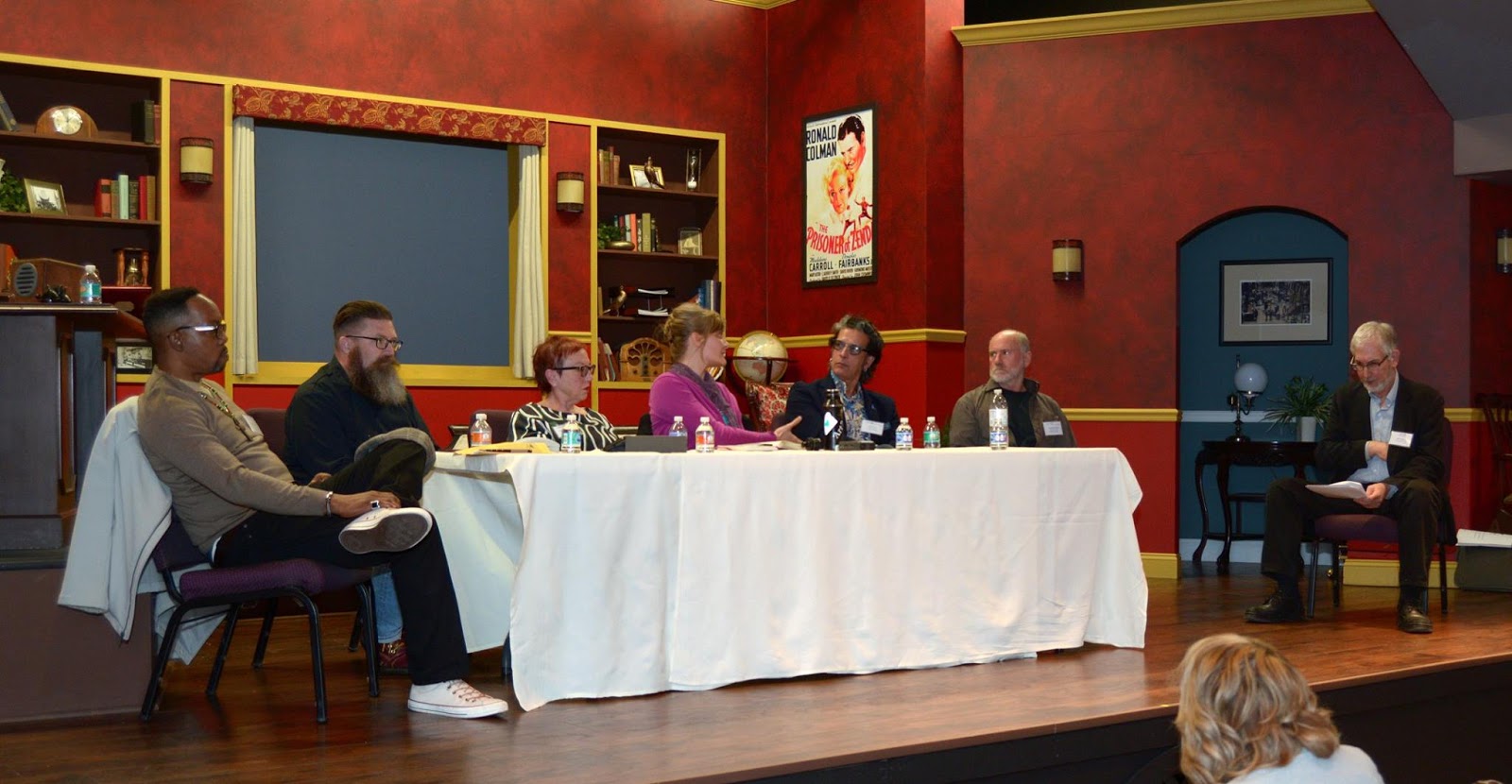
This week I had the privilege to attend the ArtC Panel Discussion at the beautiful Eagle Theatre in Hammonton, NJ. The event was organized by Bill Horin as an opportunity for the South Jersey artistic community to come together and identify challenges as well discuss ways to improve visibility of the arts in our area. Attendees included: visual and performing artists, galleries, profit and nonprofit organizations.

The night was structured into two 45 minutes panel discussions with various panelists answering previously submitted questions. To read about the panelists who were in attendance, please see the image below. Some questions were specific to the panelist's art form or organization and how artists can find opportunities.

Excerpt from ArtC Pamphlet

In the first panel discussion, I really enjoyed Paul Herron's talk about the 3 different types of artists and ways in which to be successful. The most important aspect of being an artist is knowing how to brand and market yourself. He stated that people who purchase art, invest in the artist and to "Appreciate yourself as visionary" which was very inspiring.

The perspective of Katherine Stanek, owner of the Stanek Gallery in Philadelphia, was also very interesting. She discussed why she opened an art gallery when most are closing their doors. She also explained, in great detail, the reasoning behind the commissions that galleries charge. This was very insightful, especially because Stanek is both an artist and gallery owner.

One of the most sought after panelist during the first discussion was Allison Tratner, the interim Executive Director of the New Jersey State Council on the Arts. One of the most important topics of the evening was obtaining more funding for the arts in South Jersey and having more representation. Allison did an excellent job explaining the funding the state receives and how it is allocated. I learned there is a provision that 25% of the 16 million dollar budget must be available to South Jersey organizations and nonprofits. She also encouraged attendees to sign up for the email list to be notified of art opportunities.

During the brief intermission, I introduced myself to Allison. I invited her and her colleagues from the New Jersey State Council on the Arts to come to the Salem County Arts in Bloom Studio Tour to experience the art happening in our county. I provided her with brochures and explained the different activities and offerings that will be happening during that weekend. I hope to see some representatives from Trenton!

The second panel consisted mostly of fine and performing artists who work and reside in South Jersey. They discussed the challenges that artists face and different ways to find opportunities. Joanie San Chirico explained public art projects and ways to find them. Gwenn Liberty Seemel is an artist and blogger who talked about Patreon, a site that allows an artist's followers to fund their work. An interesting concept for artists seeking financial endorsement from their patrons.

My favorite panelist from the second session was Tyrone Hart, a self taught artist from Atlantic City. He encouraged attendees to observe and pay attention to details in order to be successful. I really enjoyed how he explained the ebb and flow of an art business. To make his point, he stated that most of the time artists will eat oatmeal and on occasion they will eat steak.

I am really fortunate that I was able to attend this important discussion about the arts in South Jersey. A lot of information was provided and exchanged during the evening which definitely was a motivational experience. If you'd like to view the entire interview, please click here.

Photos by Steve Jasiecki/ArtC
I'm on right, third row back in the mint green shirt
Photos by Steve Jasiecki/ArtC

Tuesday, August 22, 2017

Art Materials & Ideas to Encourage Artistic Development

Today's blog post is a follow up post from last week's Experiencing Lowenfeld's Stages of Artistic Development with Children in Your Life. Please refer to the previous post for the descriptions of each artistic stage of development. Below are some examples of materials and ideas to encourage the child(ren) in your life at their current phase of artistic development:

Scribble Stage (Ages 2-4)
Use materials that allow the child to choose different colors and experience different mark making. Encourage the child to talk about their creations. In the beginning their drawings may not mean anything until they reach the later portion of the scribble phase known as "Naming".

Art materials:

  1. Large crayons
  2. 12" x 18" or 18" x 24" paper for drawing and painting to capture large movements
  3. Large painting brushes with thick handles for easy gripping
  4. Tempera paint
  5. Air dry clay/ play dough for sculpting
Ideas to Explore:
  1. Allow the child to draw freely
  2. Ask the child what their drawing represents


Pre-Schematic Stage (Ages 4-6)
Encourage the child to make connections from their experiences in the world and their artwork

Art Materials:
  1. Large crayons
  2. 12" x 18" or 18" x 24" paper for drawing and painting to capture large movements
  3. Large painting brushes with thick handles for easy gripping
  4. Tempera paint
  5. Watercolors
  6. Colored chalk
  7. Construction Paper
  8. Glue
  9. Air dry clay/ play dough for sculpting
Ideas to Explore:

  1. Size Relationships
  2. Feelings
  3. Body Parts

Schematic Stage (Ages 7-9)
Allow children to draw/create what they want with new art materials. Encourage them to depict natural and imaginative environments.

Art Materials:
  1. Multimedia Paper
  2. Paint Brushes
  3. Tempera Paint
  4. Watercolors
  5. Graphite Pencils
  6. Colored Chalk
  7. Oil Pastels
  8. Paper Mache
  9. Construction Paper
  10. Glue
  11. Clay
Ideas to Explore:
  1. X-Ray Pictures
  2. Front and Profile Views 
  3. Emotions
  4. Experiences in their world (going to school, dance practice, etc.)
Dawning of Realism Stage (Ages 9-11)
To encourage children to develop their artistic skills, have them draw from observation and explore other art mediums to express themselves and illustrate the way they view the world.

Art Materials:
  1. Multimedia Paper
  2. Paint Brushes
  3. Tempera Paint
  4. Watercolors
  5. Watercolor Pencils
  6. Graphite Pencils
  7. Colored Chalk
  8. Oil Pastels
  9. Paper Mache
  10. Construction Paper
  11. Glue
  12. Clay
  13. Print Making Materials
  14. Book Making Materials
  15. Photography
  16. Weaving
Ideas to Explore:
  1. Art from around the world
  2. Drawing from observation
  3. Elements and Principles of Art


Tuesday, August 15, 2017

Experiencing Lowenfeld's Stages of Artistic Development with Children in Your Life

While I was studying to become an art teacher, I was required to take many child and adolescent development classes since I would certified to teach grades K-12. In these classes we discussed the physical, emotional, and social growth that happens within childhood and how it will affect learning in a classroom setting. In my art education classes we also learned about a different type of child development: The Stages of Artistic Development by Viktor Lowenfeld. Today I am going to briefly describe these stages so you can better understand the ways in which children begin to express themselves visually.

The first stage is the Scribble Stage which occurs when children are between 2-4 years of age. In this stage children begin by scribbling their kinesthetic motions onto paper (and sometimes walls). In the late portion of this stage, children begin to name or tell stories about their drawings. This is the shift from the kinesthetic thinking to imaginative thinking with the ability to visualize pictures.

Children then move into the Pre-Schematic Stage when they are approximately 4-6 years of age. This occurs when children begin to draw images that represent either animal or human figures. They create connections with the shapes that they draw to objects in the physical world around them. The most important aspects of the subject are emphasized and the use of color is more emotional than logical.

The next stage of artistic development is the Schematic Stage which occurs when the children are about 7-9 years old. In this stage, shapes are assigned to objects and they are attempting to communicate with the images they create. Another important development is spacial awareness and the appearance of sky and ground relationships.

Children then move onto the Dawning of Realism stage when they are about 9-11 years old. Realism is more about the experience with the object rather than photographic representation of it. Drawings at this stage also have defined steps to the process. Enhanced understanding of space with the use of overlapping also appears. This is also the time in the development of children where self awareness appears as well as self criticism which can hinder the development of their artistic abilities.

The final stage of artistic development in childhood is the Pseudo-Realistic Stage which occurs when children are about 11-13 years old. In this stage, the product becomes more important than the process. They try to mimic the shapes and values that they see in the real world to create works of art that are ready for "stage presentation". Children will also make visual and emotional connections to the objects from the physical world through their drawings. 

Credit: Laurie E. Meyers showcasing Viktor Lowenfeld's Stages of Artistic Development


As a mother, I am now experiencing the beginning of Lowenfeld's stages with my oldest child, Courtney. She is currently in the Pre-Schematic Stage where she is beginning to draw things that represent people or animals. Below are some unprompted pictures drawn by Courtney. It is so much fun to listen to her talk about her drawings and what she is trying to represent with her creations. In a future blog post I will provide you with suggested art materials and ideas to share with your child to encourage their development in their current stage.


References

Clements, Robert D., and Frank Wachowiak. Emphasis Art: A Qualitative Art Program for Elementary and Middle Schools. Allyn & Bacon, 2010

“Lowenfeld's Stages of Artistic Development.” LOWENFELD, www.d.umn.edu/~jbrutger/Lowenf.html.

“Viktor Lowenfeld's Stages of Artistic Development.” Ms. Lewis' Art Stars, www.mslewisartstars.com/viktor-lowenfelds-stages-of-artistic-development.html.